02 September 2026
The Italian economic environment is showing signs of greater stability, but financial professionals remain cautious about the outlook for the coming months. According to the latest CFA Society Italy-Radiocor Financial Business Survey, conducted between 19 and 31 August 2026 among CFA Society Italy members, perceptions of current conditions have improved slightly, while expectations for economic growth remain subdued.
The assessment of Italy’s present economic situation is somewhat more constructive than in the previous survey. 68.2% of respondents describe conditions as stable, while 9.1% view them positively and 22.7% negatively. The balance between positive and negative assessments consequently improves to -13.6 points, suggesting that despite geopolitical tensions and uncertainty surrounding the global economic cycle, respondents do not currently anticipate a significant deterioration.
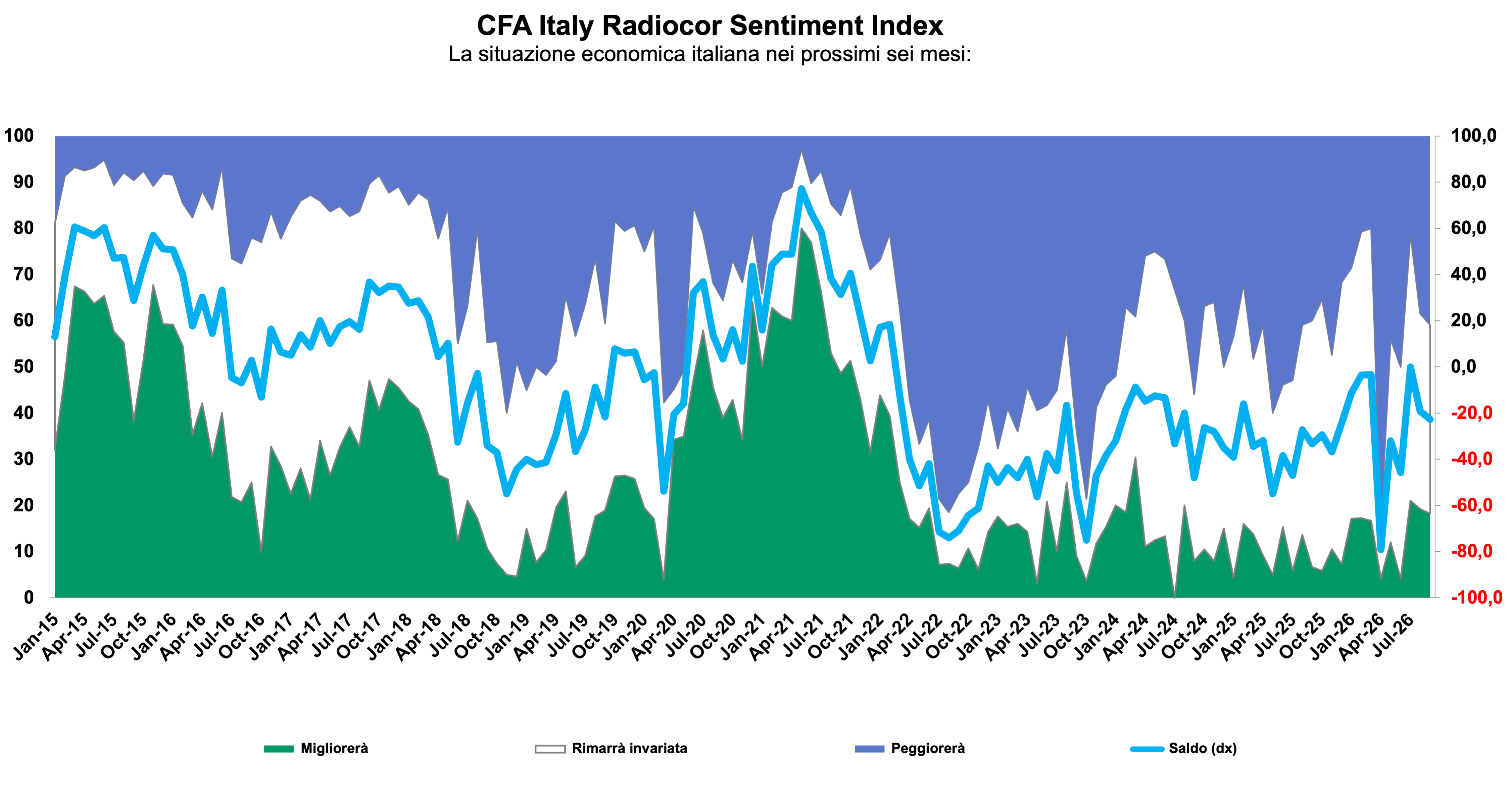
The outlook over the next six months remains more challenging. The CFA Society Italy-Radiocor Sentiment Index, which measures the difference between expectations of improvement and deterioration in the Italian economy, stands at -22.7 points, broadly unchanged from the previous month. 18.2% of respondents expect economic conditions to improve, while 40.9% anticipate little change and an equal proportion expect conditions to worsen.
Caution increases across the Eurozone
Expectations have become more subdued elsewhere in Europe. The balance for the Eurozone falls to -18.2 points, indicating increased caution over the region’s growth prospects. Sentiment towards the United States also remains negative at -27.3 points, although this represents a modest improvement from the previous survey.
US inflation expectations rise sharply
Inflation remains an important concern. In both Italy and the Eurozone, the balance between respondents expecting inflation to increase and those anticipating a decline stands at 18.2 points, indicating continued expectations of moderately rising prices. The most significant shift concerns the United States, where the balance jumps to 50 points, signalling a substantial strengthening of inflation expectations.
The outlook for interest rates reflects these concerns. Expectations for higher short-term rates remain firmly positive, with balances of 45.5 points in Italy and 36.4 points in both the Eurozone and the United States. The upward pressure is even more pronounced at the long end of the yield curve. Expectations for higher long-term interest rates stand at 40.9 points in Italy, 36.4 points in the Eurozone and as high as 63.6 points in the United States, highlighting a significant upward revision in expectations for US bond yields.
European equities retain a modest advantage
Despite the cautious macroeconomic backdrop, respondents remain moderately constructive on European equities. The FTSE MIB maintains a positive balance of 9.1 points, while expectations for the FTSE STAR are broadly neutral. The Euro Stoxx 50 also remains marginally positive at 4.5 points. The picture is weaker for US equities. Sentiment towards the S&P 500 falls back into negative territory at -9.1 points, reinforcing the more cautious view of US financial markets emerging elsewhere in the survey.
Utilities lead sector preferences
At sector level, respondents favour areas perceived as relatively defensive. Utilities rank first with a balance of 30 points, followed by banks at 26.3, insurance and telecommunications at 22.2 each, and oil & gas at 21.1 points. The outlook remains particularly challenging for cyclical industrial sectors. Automotive records the weakest reading at -55 points, followed by industrial machinery at -50 and construction at -44.4 points.
Dollar weakness gains consensus
Expectations of a weaker US dollar against the euro have strengthened considerably, with the balance declining to -28.6 points. This indicates a clear majority of respondents now anticipate depreciation of the US currency. The outlook for the Japanese yen remains positive, with a balance of +15 points. Finally, expectations for oil prices have reversed direction. 31.8% of respondents now expect prices to rise over the next six months, compared with 27.3% anticipating a decline, while 40.9% foresee little change. The resulting balance of +4.5 points reflects renewed attention to geopolitical tensions in the Middle East.
The September survey therefore paints a picture of stability without strong conviction on growth. While perceptions of Italy’s current economic conditions have improved modestly, expectations remain cautious across the major developed economies. At the same time, persistent inflation concerns and expectations of higher interest rates - particularly in the United States - continue to shape investors’ views across bonds, equities and currencies.